
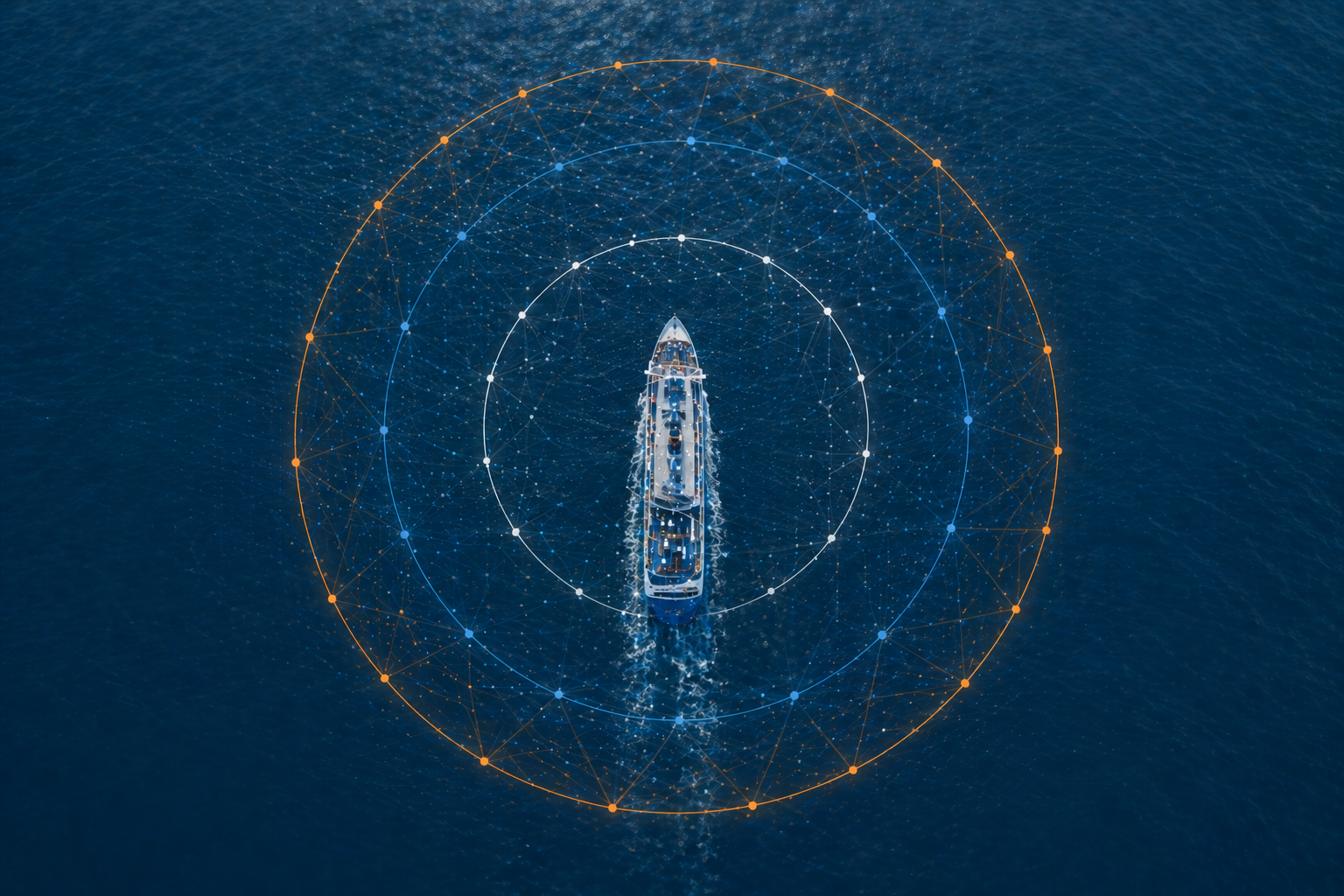
The third layer is ownership and control of a proprietary, land-based maritime network. This network acts as a high-capacity, low-latency backbone (the core system that carries most of the data traffic efficiently) wherever coverage exists. Satellite and mobile networks are still used, but only where they add value, not as the default.
“The industry has been solving connectivity in two layers – coverage or performance,” says CEO Asbjørn Frydenlund.
“The third layer is new. A new network. Which we own and control, and when you do that, you control the outcome.”
What the Extra Layer Means in Practice
With Nowhere Networks solution you get one unified system that continuously optimizes itself.
- Traffic is intelligently routed onboard (deciding what data goes where).
- Capacity is allocated dynamically (adjusted in real time based on demand).
- Each data type uses the most efficient available network.
The result is structural:
- Significantly higher usable capacity on existing routes.
- Up to 90% lower connectivity costs compared to satellite-heavy setups.
- Consistent, predictable performance for both operations and passengers.
- One integrated supplier instead of multiple vendors.
“When you own the backbone, you stop adapting to limitations, you remove them,” Frydenlund adds.
Why This Matters Now
Connectivity demand at sea is no longer stable – it’s accelerating.
- Passengers expect seamless, onshore-like experiences
- Crew depend on reliable, always-on communication
- Critical systems are moving to the cloud
Traditional hybrid solutions struggle here, not because they lack technology, but because they lack control. Adding more bandwidth doesn’t solve the problem if you can’t manage how it’s used.
From Combination to Control
Many providers offer hybrid connectivity. But few control the full system behind it, and that’s where inefficiencies, costs, and performance issues arise. Nowhere Networks changes that by owning the infrastructure and orchestrating all technologies as one. The result is a system designed to perform, route by route, vessel by vessel.
Start Controlling Your Connectivity
If your current setup is built on compromises, it’s time to rethink the foundation.
With the third layer, connectivity becomes:
- Predictable
- Scalable
- Cost-efficient